Showing posts with label CUNY. Show all posts

Sunday, February 23, 2014

Adapiformes

The Adapiformes are primitive euprimates who's fossils range from the early Eocene to the late Miocene. Famously, the first discovery was mis-identified as an early ungulate and thus named Adapis parisiensis, as in 'towards Apis, the sacred and mythical bull'.

Groups

The major adapiforme groups are:
  1. Notharctidae (North American adapiformes)
    1. Notharctinae
    2. Cercamoniinae
  2. Adapidae
    1. Adapinae (European adapiformes)
  3. Sivaldapidae (south-east Asia adapiformes)
Additionally there are problematic taxa, particularly from Asia and Africa (which here includes Oman).

The Notharctine Cantius is the earliest adapiforme in North America and also one of the earliest in Europe.


Bodies

Body sizes range from around 1kg to 7kg for Notharctus robustior, with a few species weighing less than 500g, and one, Anchomys gaillardi weighing around 50g. Gingerich (1977) famously showed a gradual evolutionary trend for body-size increase amoung some Adapiformes. Gould and Eldridge cited this case in their famous punctuated equilibria discussion as an example however of the data not meeting the gradualistic interpretation matched with it (Figure 1).
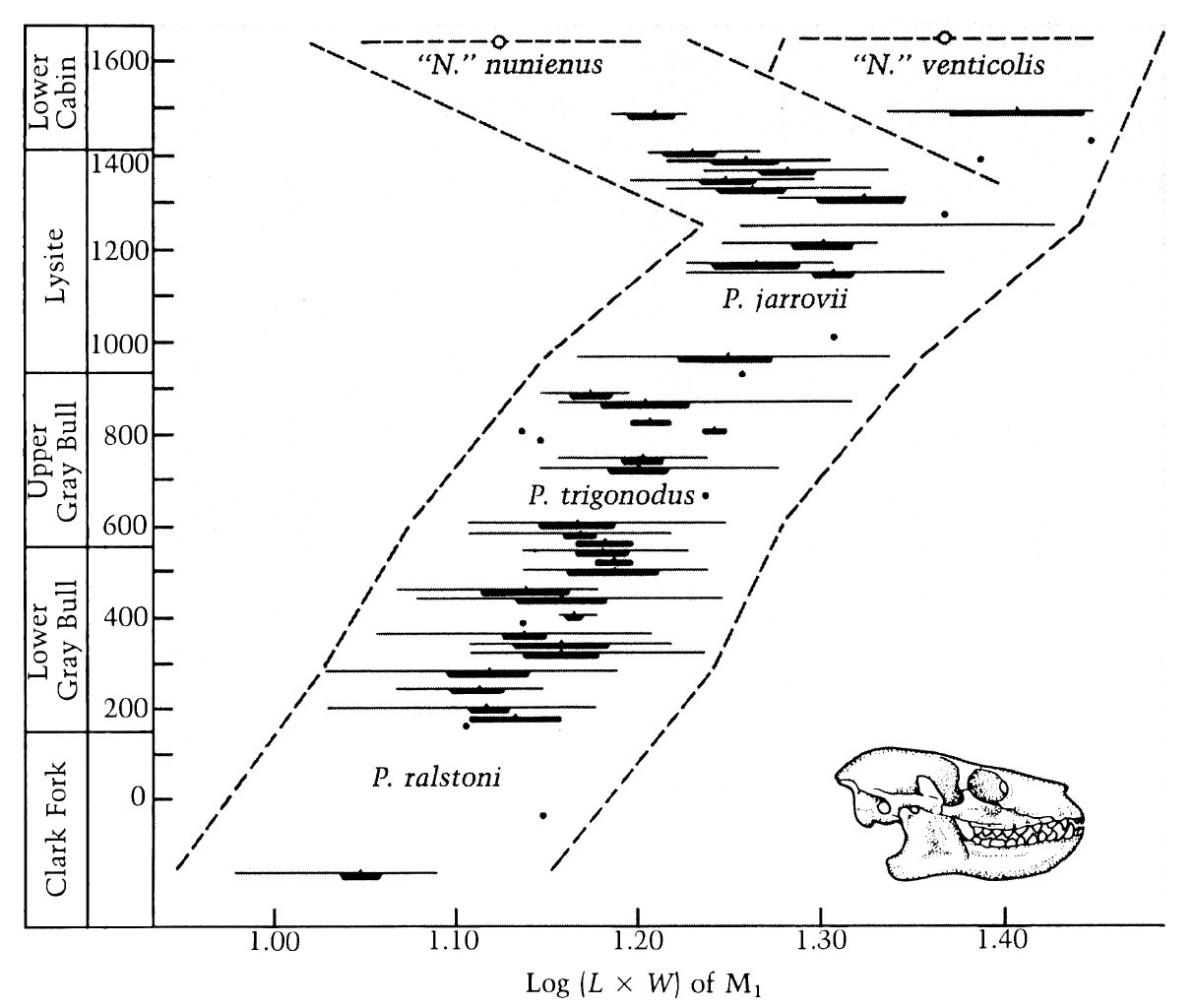
Figure1 

Adapiformes have sloping facets of their ankle bones and and characters of the distal tibia (presumably that link with the ankle features) that associate them with Lemuriformes (lemurs and lorises). They possess a post orbital bar, thus linking them with all other euprimates. Adapids had a dental formula of 2143 (early ones at least), lack a hypocone, have an elevated trigonid, and an unfused mandibular symphysis. Adapids have a petrosal bulla with a ring-like ectotypmanic included within the bulla (bullar morphology receives a lot of attention in primate systematics).  In the cheiridia, adapiformes have opposable first digits for grasping. Their orbits are obliquely facing allowing for some stereoscopic vision and the lacrimal is included within the orbit. Their snouts are large and have lots of turbinates. Some workers have been able to pick out (in some specimens) boney features (such as a gap between the upper incisors) that might correlate with the wet-nosed' condition of modern strepsirrhines. Some have, in a heterodox position, listed a set of features thought to link adapiforms to anthropoids, in particular the cercamoniine adapiformes.

Adapiformes generally have mobile shoulder joints, which makes sense for active arboreal species.

Some notharctines were potentially vertical clingers and leapers, having short and high trochlea with the capitulum extending below the trochlea. For these  potential VCL-ers, the elbow may not have allowed the forearm to fully extend, but the forearm may have had good twisting ability. Potentially arguing against the VCL hypothesis, none of the notharctines have knees like those of tarsiers and galagos, which are specialized leapers.

Adapines were different; they were possibly slow-climbing arboreal quadrupeds, agile but non-leapers. They were potentially loris like in their habits.

Diet

Some adapiforms have good zyogmatics and saggital crests suggesting more frugivorous or folivorous diets. The tiny Anchomys had insectivore-like teeth, and other small forms may also have been insectivorous. Most other species are over 1kg and were likey frugi/folivores. Covert (1986) found a high molar shearing coefficient (`spikiness' of teeth) for Adapis, Leptadapis, Notharctus, Caenopithecus, and Smilodectes (which are also larger adapiforms). The Sivaladapids also have folivorous molar shearing coefficients.

Climate
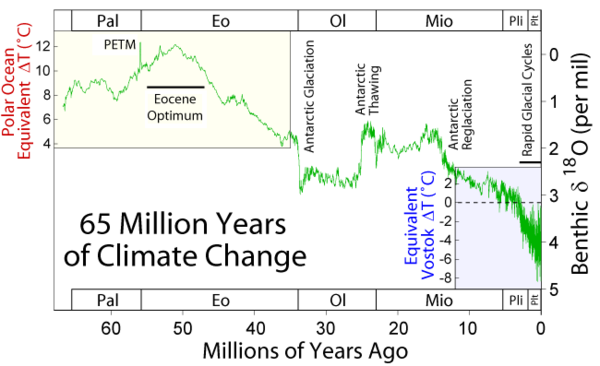
Figure 2
The Paleocene-Eocene Thermal Maximum (PETM) was the warmest period on Earth throughout the Cenozoic. The early Eocene was very warm, likely tropical with little seasonality. Climate declined and cooled throughout the Eocene, by the end of which Antarctic icesheets had formed. Around the end of the Oligocene the climate started warming again, fluctuating through most of the Miocene until heading into the decline the eventual leads the the episodic Ice Ages of the later cenozoic (Figure 2). Adapiforme diversity and geographic spread basically follows this same story of a peak in the early/middle Eocene followed by a long decline. By the middle Miocene all that's left are Sivaladapids in south asia.


Friday, July 26, 2013

Fantastic Bridges

This was pointed out to me by someone else, it's an odd glitch in google maps.


  The map shows south Brooklyn. Manhattan Beach is on the east-end of a  bit of land on the southern base of Brooklyn, with Coney Island at the west-end. The long strip at the bottom of the screen capture is a barrier island, made up of  Breezy Point and the Rockaways.  This map shows a bridge extending from Breezy Point into Manhattan Beach. There's no such bridge.


Here we're zoomed in on the north end of the 'bridge', and it actually is shown running into the CUNY Kingsborough Community College campus.
In fact a big chunk of the campus here is mysteriously shown as under water.
There's nothing like any of this in the satellite view, shown below.

Outside of this being a weird map rendering issue---and the error is not normally there, I've checked this map before---my first thought was, maybe it's a projection involving potential sea-level rise. But that wouldn't explain the "bridge", which is also rather wide for a bridge. Plus, the campus has a high sea-wall running all around it, so if the south end of it was flooded, the whole campus should be flooded. Water could be coming in to the west, off campus, and run into campus, but I'd think if that was the case then there'd be more flooding overall. Anyway, it's probably not the case that 'someone' at Google accidentally put in data from some imaginary flood scenario into the standard Google Map.


I actually wish this bridge did exist, it'd be better taking the Southern Parkway and driving through the Rockaways, and then over this bridge, than taking the dread Belt Parkway.

Thursday, June 09, 2011

via Storify

E-Portfolios and Cats

re: http://nogoodreason.typepad.co.uk/no_good_reason/2011/06/eportfolios-all-thats-wrong-with-ed-tech.html

The crux of the above post is that e-portfolios were all the rage, but the fell out of favour because they add unnecessary complications, are de-socialized, have a steep learning curve, and often quickly just became ways to submit student work.

They are still alive at our campus. I don't use them and don't know anyone that uses them, but I occasionally see campus-wide-list-emails about them. Development of e-portfolios is managed by our 'Center for Advanced Technologies Training', along with many other systems, like BlackBoard, Blogs, and Wikis. Most of our faculty doesn't have their Faculty Profile webpage set up though, so I suspect that these resources are under-utilized. I know the people at our CATT and they are great, extremely helpful, so I have to think that what the above post suggests is true about a lot of electronic systems.

One comment on the above blog is interesting:
So e-portfolios are problematic if you're talking about education and learning, but in the context of schooling - the real world in which most people live, they work just fine (or as well as anything does...).
This highlights the difference between Actual Learning and Scholasticism. On the one hand our students, and this seems to be true everywhere regardless of what people say, are expected to basically jump through a set of hoops. And they approach it as such, tasks to check off in order to move up.
I was at a graduation ceremony this weekend at a high level private high school. The Valedictorian actually said just that, that they learned nothing in their school other than to use things like cliff and spark notes, and that putting work off until the night before was actually better than doing it ahead of time, not merely acceptable or sufficient but preferable because they can focus on other things to learn that are important (and he did not mean academic matters).

So it sounds like e-portfolios are great, as long as you want the same-old-same-old, or as long as you want 'top performing students' who are doing nothing.
I'll have to actually try to verify that though, maybe I need to talk to the guys over at our CATT.

Monday, May 16, 2011

Library Shitstorm

Apparently there is much internet-drama in the world of Libraries and Librarians. Many of the librarians actually have a name for their world of Library-related blogs, the biblioblogosphere, that's cute. The problem seems to have started more or less when a 'big shot' librarian at a Canadian University said that, 'rather than hire new Librarians to replace those retiring and others that will be forced out, we're going to replace them with PhDs and the like. No more librarians at the library'. This drove the biblioblogosphere berserk.
On the one hand, this sounds fine, replace people that specialize in whatever librarians do with subject matter experts. But there's such an uproar amoung the 'glasses on a chain' crowd, that I have to wonder, have I not been making use of my librarians? The librarians I've had contact with are great people, they are helpful. At Adelphi, one of the librarians actually met with our class, all pro-active like, and distributed a book-let she had written on using the library for science research, and also included proper citation methods. I still have it, it's useful. The librarians at Kingsborough are also really good, I usually have my students do a research project, and I insist that they learn to use the library databases, rather than google, for their research. One of the librarians there meets with my class, usually for two sessions, showing them how to use the database, how to come up with a research project, rather than just making up some idea and 'googling' it.
But clearly that sort of thing doesn't require a Master's in Library Science, so why insist on Librarians?
I don't know why, so I think I need to find out what else the librarians can be doing for me.