So today my '03 Malibu had to be returned. I had thought that I was working with GMAC, I had thought that they were going to let me decide today even (though I was late returning my car after its smartbuy was up) whether to refinance the balloon payment OR get into a new lease. But apparently I thought wrong. They told me today, when I called them to say that I wasn't going to get a new vehicle and, rather, I would sign the contract that they had sent me to refinance the ballon payment, that they didn't want to do that, and that they're requiring me to turn it in to one of their dealers.
So now I have no car. This is wonderful. I had thought all those things because....thats what we'd do when I worked at GMAC, we'd work with people who were overdue on turning in their car, either have them sign an extension while they were trying to make a final decision, or try to get them to sign a new contract. And when I had spoken to the people at GMAC's Midland Center, I made it clear to them that I was trying to decide between the two options, but needed to wait for a certain ticket from my former GMAC co-workers that'd give me a discount on any new vehicle I got into. Later I got a phone call from someone from the Hartford branch, I explained the situation to him, and said I'd be able to get back to him by today either way. I thought everything was fine. Yesterday I get the ticket, contact a couple of dealers, and decided that it wasn't worth getting the new car. I call the guy from Hartford to let him know that I'm going to sign the contract for the refinance, and he tells me no. To turn the car in, now, or else its going to be re-possesed.
I argued with this idiot for a while. In the end, I had no choice but to turn it in, and now I don't have a car of my own. I suppose that its actualy in my favour. THe car was old at this point and had over 50K miles on it. It'd be a bad deal to have to pay around $12K for a 3-yo car with 50K miles on it. I'll have to pay an overmileage charge for part of that of course now also. But you'd think that the guy would prefer that I send in a check. The first payment for the refinancing wouldn't even be due until next month even. How much of a difference does it rationally make if I signed the contract 10 days ago or today, and then sent the first payment in next month??? Not a helluva lot.
And I offered to pay for an extension to cover the time between now and when it was due back, on top of signing the new 36 month refinancing contract. But no, apparently, that'd be against GMAC's interest. Unbeleivable.
So there's simply now way that I'm going to be getting any of the family of GM cars now. Even if other companies would do the same, they haven't done it to me, and if it ever did happen, hell, at least they wouldn't be doing it to a former co-worker. Half the people in that nitwit's office are 'refugees' from my old office too. Apparently it counts for nothing. Heck, he even went so far as to say that 'I should know better then because I worked for GMAC'. Well when I worked for GMAC getting cars that were past maturity and overdue, we'd actually do stuff that made sense. This moron couldn't do anything other than say that the car in his que has to be returned.
Tuesday, October 17, 2006

Monday, September 11, 2006
TA Work
I've started the TA position, and its pretty hectic. I was told at first that I'd have 3 lab periods, and then a few days before I was told I'd have 2 labs a week. But then it turns out that there are 4 labs a week,, everyday in the late afternoon except Friday. On Friday I need to come in to prepare for the labs on the following week. They're around 3 hours each, and the prep on Friday can take a few hours on its own.
The Thursday Lab actually conflicts with my Marine Geology class, which starts at 6, but the Lab Professor, who is the Head of the Biology Department, is ok with me leaving for that class. Infact, often the labs end a little bit early.
For my research, I need to still pick the samples for the Mg:Ca analysis, and then prep them at the Hofstra Lab. I should hear back from Hofstra soon as to when I can some in and do that, and picking the samples shouldn't take more than one session at the microscope.
The Thursday Lab actually conflicts with my Marine Geology class, which starts at 6, but the Lab Professor, who is the Head of the Biology Department, is ok with me leaving for that class. Infact, often the labs end a little bit early.
For my research, I need to still pick the samples for the Mg:Ca analysis, and then prep them at the Hofstra Lab. I should hear back from Hofstra soon as to when I can some in and do that, and picking the samples shouldn't take more than one session at the microscope.
Saturday, August 19, 2006
Procedural Corrections
After picking around 300 individuals of G. bulloides from my six sample sets, I was able to successfully clean them over at the Hofstra Lab. Dr. Farmer was very helpful during this process.
I only had the two seives that she had created, but I don't think I would've used more than that to clean them at once.
Procedure:
I brushed the samples into the seive, then marked down which seive correlated to which sample.
I placed the seives into a regular beaker that had enough methanol to fill to the half-mark of the seives.
I placed the beaker into the sonicator, and sonicated for 3 minutes.
After sonication, I removed the beaker and then the seives from the beaker quickly and placed them on a paper towel to dry. This took a few minutes.
I then carefully tapped out the seives onto fresh weighing paper.
I curled or folded the weighing paper and poured the forams into a numered jar, which was underlain by another peice of weighing paper in case of any spillage.
I then marked down which jar had which sample.
There were some problems. The first two samples I sonicated for 5 minutes, but that turned out to be too long, they became broken up. This made it difficult to remove them from the seive or get them off the weighing paper and into the jar. I had to use a brush to do this. I used a different brush for each one, but the first brush was the brush I had used to get them into the seives previous to cleaning. It seemed like some of the sample was lost because of the breakage. After those first two, I switched, upon the advice of Dr. Farmer, to a 3 minute sonication, and no more breakage occured. The samples easily fell out of the seives and poured off the weighing paper.
Breaking in itself shouldn't be a problem, the samples are going to be crushed, vapourized, and then, to further abuse them, that vapour gets scorched into soot and that soot is analyzed for the actual dating.
At one point, I neglected to record which sample was in what seive until after sonication had started. I am nearly certain that I remembered which was which, but there is a chance that, say, sample 3 is marked as "4". This should be corrected by the carbon 14 dating.
I only had the two seives that she had created, but I don't think I would've used more than that to clean them at once.
Procedure:
I brushed the samples into the seive, then marked down which seive correlated to which sample.
I placed the seives into a regular beaker that had enough methanol to fill to the half-mark of the seives.
I placed the beaker into the sonicator, and sonicated for 3 minutes.
After sonication, I removed the beaker and then the seives from the beaker quickly and placed them on a paper towel to dry. This took a few minutes.
I then carefully tapped out the seives onto fresh weighing paper.
I curled or folded the weighing paper and poured the forams into a numered jar, which was underlain by another peice of weighing paper in case of any spillage.
I then marked down which jar had which sample.
There were some problems. The first two samples I sonicated for 5 minutes, but that turned out to be too long, they became broken up. This made it difficult to remove them from the seive or get them off the weighing paper and into the jar. I had to use a brush to do this. I used a different brush for each one, but the first brush was the brush I had used to get them into the seives previous to cleaning. It seemed like some of the sample was lost because of the breakage. After those first two, I switched, upon the advice of Dr. Farmer, to a 3 minute sonication, and no more breakage occured. The samples easily fell out of the seives and poured off the weighing paper.
Breaking in itself shouldn't be a problem, the samples are going to be crushed, vapourized, and then, to further abuse them, that vapour gets scorched into soot and that soot is analyzed for the actual dating.
At one point, I neglected to record which sample was in what seive until after sonication had started. I am nearly certain that I remembered which was which, but there is a chance that, say, sample 3 is marked as "4". This should be corrected by the carbon 14 dating.
Sunday, August 13, 2006
Mawage
Today, I finally managed to propose to my girlfriend, now my fiance. Thats got a nice ring to it, literally I suppose.
It almost didn't happen today either. I had planned on going to the Stroll Garden, but she didn't think she could get there in time for it to be worth it, so we ended up going to someplace nearby. I made like I was just taking photos with my camera, I had it on a tripod and had a shutter release cable, so I could take photos of us together. After snapping shots for a while, I made like we were going to take just another photo together. She was getting tired of it and was ready to leave. Before I tripped the shutter, I pulled the ring out of my pocked and said, "So, you wanna get married?".
Not the traditional format, I suppose, but it worked!
It almost didn't happen today either. I had planned on going to the Stroll Garden, but she didn't think she could get there in time for it to be worth it, so we ended up going to someplace nearby. I made like I was just taking photos with my camera, I had it on a tripod and had a shutter release cable, so I could take photos of us together. After snapping shots for a while, I made like we were going to take just another photo together. She was getting tired of it and was ready to leave. Before I tripped the shutter, I pulled the ring out of my pocked and said, "So, you wanna get married?".
Not the traditional format, I suppose, but it worked!
Friday, August 11, 2006
Meeting with the Parents
On 8/11 I met with my girlfriend's parents in order to ask her father for his permission to marry her.
I was terrified in the lead up, incredibly nervous. I drove to a bookstore nearby to calm down, browsed around, bought two books, and called them, asking to stop by. I am certain that they knew why. The most nerve wracking part was that first phone call. I had been putting it off for far too long, and now that it was over, I wouldn't say I wasn't nervous at all, but I could deal with it.
I get to the door, and her mother answered, huge smile on her face. Thats a good thing! Her father was on the phone talking to one of the relatives I beleive. I think that her mother was a little excitable, she called her husband on her cell phone to get him off the phone. He say down, I explained and asked, and he happily said yes.
The expected questions followed, what I plan on doing, they asked in more detail about my own family, etc etc. I didn't expect them to say no or anything along those lines, but still, it was great that they said yes and chatted about it. After a while I left, because they had to get ready for a physical therapy session, her father had broken his arm just a short while ago and was heading back to work after the weekend. All in all, it went very nicely. One thing that might've been a faux pas, I mentioned that I had already bought the ring, I wanted to let them know that it was happening before long. But in retrospect, that seems out of place, why am I asking their permission, yet I already purchased the ring? Seems forward no, and sort of nullifies her father having any say no?
I am making a point of not telling my parents, since they've been anxious for me to go over there and talk to him. My girlfriend is expecting the proposal, but, in large part because I've delayed in speaking to her father, she has no idea when its going to happen. She should be surprised. This way my parents will be surprised too. Just having a little fun with that.
....
Later this same evening, I went back over their house to hang out with her, we were planning on watching a movie. Turns out, her parents mentioned that I stopped by. I didn't tell them to not tell her, I had just assumed that thats the normal way things go. Her parents hadn't intended anything by it, they assumed that she had known that I was stopping by that day. Shouldn't really matter all that much, she's known for a while that I would be coming by, this just means that she knows the big event will happen before long.
I was terrified in the lead up, incredibly nervous. I drove to a bookstore nearby to calm down, browsed around, bought two books, and called them, asking to stop by. I am certain that they knew why. The most nerve wracking part was that first phone call. I had been putting it off for far too long, and now that it was over, I wouldn't say I wasn't nervous at all, but I could deal with it.
I get to the door, and her mother answered, huge smile on her face. Thats a good thing! Her father was on the phone talking to one of the relatives I beleive. I think that her mother was a little excitable, she called her husband on her cell phone to get him off the phone. He say down, I explained and asked, and he happily said yes.
The expected questions followed, what I plan on doing, they asked in more detail about my own family, etc etc. I didn't expect them to say no or anything along those lines, but still, it was great that they said yes and chatted about it. After a while I left, because they had to get ready for a physical therapy session, her father had broken his arm just a short while ago and was heading back to work after the weekend. All in all, it went very nicely. One thing that might've been a faux pas, I mentioned that I had already bought the ring, I wanted to let them know that it was happening before long. But in retrospect, that seems out of place, why am I asking their permission, yet I already purchased the ring? Seems forward no, and sort of nullifies her father having any say no?
I am making a point of not telling my parents, since they've been anxious for me to go over there and talk to him. My girlfriend is expecting the proposal, but, in large part because I've delayed in speaking to her father, she has no idea when its going to happen. She should be surprised. This way my parents will be surprised too. Just having a little fun with that.
....
Later this same evening, I went back over their house to hang out with her, we were planning on watching a movie. Turns out, her parents mentioned that I stopped by. I didn't tell them to not tell her, I had just assumed that thats the normal way things go. Her parents hadn't intended anything by it, they assumed that she had known that I was stopping by that day. Shouldn't really matter all that much, she's known for a while that I would be coming by, this just means that she knows the big event will happen before long.
Thursday, August 10, 2006
Technical Difficulties

Technically, today was a disaster in the lab. For the past week I've been 'picking forams' for analysis. We are going to have the carbon-dated. I needed to pick out around 300 individuals of one species, Globigerina bulloides. That was expected to give me around the 10 miligrams of sample that were needed. Six sets, each from a different depth of the ocean drilling project core, were selected, those were the points that we wanted dates for.
So I pulled the specimins, and brought them over to the Hofstra lab, there is a professor/researcher there who has the lab materials and has similar research interests and was kindly enough to permit me to clean the samples there. This is a necessary preparation step before they are sent away to be C14 dated.
I had to put the specimins into a small seive that she had created (six seives, one for each set of 300). These were then split up into two large beakers, which were filled with methanol to about the middle of the seives, which were now partly submerged. These beakers were then put into a sonicator, a device that has a water bath and that vibrates, the vibration will travel through the water to the methanol and mix the methanol with any dirt, clay, sediment, and other carbon bearing materials that need to be eleminated. The non-foram carbon will screw the analysis.
After sonicating for about five minutes, I remove the beakers and take out the seives to let them dry. They dry quickly, because the methanol just evaporates away. I started brushing one of the samples out of its seive, but noticed that a glue used to hold the tiny cloth-like seive screen to the seive had become very soft. The forams were sticking to it.
Crap!
Thats not good! Forams bound up with glue! Thats allways bad no?
I hoped it was just because they weren't completely dry, so I put it down and gave them more time to dry. But it was no good, the glue dried, but at least half of the sample was bound up within it. I brushed out what I could. The Hofstra professor was completely shocked and I could tell that she was mortified and very concerned. She had created the seives herself, and had used them for the same purpose, and nothing like that happened. She speculated that perhaps the glue she used had aged and changed to become unstable somehow. We tried sonicating two seives again, hoping to loosen it completely and set the forams free. I set the sonicator timer for 10 minutes, and it did soften and loosen up, but the foram material was just immpossible to seperate. I though maybe it would be possible to dissolve the glue somehow, or flush it with methanol from a squeeze bottle, to get them out, and then perhaps boil it down on a steam bath, leaving just the forams and vapourizing the dissolved glue, but the glue wasn't necessarily dissolving, just softening.
Fortunately, the professor was able to find a different glue. We pulled one screen off its seive-ring, it had been loosened that much by the sonication, and used this other glue to hold it on. The rings for the seives are some type of acrylic, and the glue was methylene chloride, a glue for acrylics. We were worried that the seive screen itself wouldn't bind, but it turned out to work nicely once she assembled one under a hood. I was concerned that the methylene chloride would react badly with the methanol once we put it to use, so we threw in some sand and tested one out. It worked perfectly, the stuff held together, and the sand grains, a decent enough proxy for forams, didn't stick at all.
So I lost the samples for the most part, and basically have to pick them all again. I only say that it was 'technically' a disaster because I just wasn't too upset over it. Something allways goes wrong, something that forces you to start all over, and usually it happens a few times. Hopefully this is the only time it happens with this C-14 dating project, but who knows.
Yoga
Recently, I took some yoga classes. They were for beginers, I had no prior experience with it. It was taking. I took the course at a community college. Most of the stretches were entirely unfamiliar to me, but a few weren't. That was surprsinging. They ended up being basic stretches that we'd do for wrestling practice in high school. I suppose that isn't to be unexpected, but it was odd to see them as recognized yoga movements.
The instructor for the course seemed to be very much into yoga, and made references to having been in ashrams in the past. That indicates that they're very serious, and have been doing it for a while, I'd think. Yet the instructor was very friendly, she didn't push anyone into any positions, as I have heard they sometimes do, and insisted that everyone merely move up to the edge of being uncomfortable, but not to hurt themselves. She insisted that that would be extremely out of place in a yoga class, and seemed to be saying that other places will insist that you do this, but they are wrong.
One thing in particular I found intresting. I have heard about yoga being done to activate all sorts of whacky mystical "energies" (the term never sensibly defined). I can't say what the instructor beleived, but she did tell us to take notice of how you feel after moving into the positions. She explained that the sensations in the limbs and body were largely resulting from the movement of blood. Raise the arms above the body, and hold them there for a time, and the blood will, to a degree, drain out of it. Twist the torso, and the lymphatic fluid will be moved about. I'd assume that intersitial fluids would be worked around as you move into and out of position also.
Perhaps this is what is really meant by these activations of energies and chakras and whathaveyou. Yoga in general is considered very ancient. I'd expect that ancient man might've been curious about those senstations, and perhaps attributed some sort of meaning to them, and that that might explain part of why yoga becomes so important in many societies.
Ultimately, yoga seems as "nothing more" than the simply movement of the body, not at all dissimilar to physical exercise. Before hand, I had considered it as a different sort of activity, it seemed as something people approached as a mystic happening, heavy on the meditation. This course invovled mediation also, and clearly a short 8 session course can't tell you too much about any subject, let alone something with as long a history and varied a practice as yoga. I don't think that I understand it on any level of detail, but it was an intruiging experience and at least now it is de-mystified for me.
The instructor for the course seemed to be very much into yoga, and made references to having been in ashrams in the past. That indicates that they're very serious, and have been doing it for a while, I'd think. Yet the instructor was very friendly, she didn't push anyone into any positions, as I have heard they sometimes do, and insisted that everyone merely move up to the edge of being uncomfortable, but not to hurt themselves. She insisted that that would be extremely out of place in a yoga class, and seemed to be saying that other places will insist that you do this, but they are wrong.
One thing in particular I found intresting. I have heard about yoga being done to activate all sorts of whacky mystical "energies" (the term never sensibly defined). I can't say what the instructor beleived, but she did tell us to take notice of how you feel after moving into the positions. She explained that the sensations in the limbs and body were largely resulting from the movement of blood. Raise the arms above the body, and hold them there for a time, and the blood will, to a degree, drain out of it. Twist the torso, and the lymphatic fluid will be moved about. I'd assume that intersitial fluids would be worked around as you move into and out of position also.
Perhaps this is what is really meant by these activations of energies and chakras and whathaveyou. Yoga in general is considered very ancient. I'd expect that ancient man might've been curious about those senstations, and perhaps attributed some sort of meaning to them, and that that might explain part of why yoga becomes so important in many societies.
Ultimately, yoga seems as "nothing more" than the simply movement of the body, not at all dissimilar to physical exercise. Before hand, I had considered it as a different sort of activity, it seemed as something people approached as a mystic happening, heavy on the meditation. This course invovled mediation also, and clearly a short 8 session course can't tell you too much about any subject, let alone something with as long a history and varied a practice as yoga. I don't think that I understand it on any level of detail, but it was an intruiging experience and at least now it is de-mystified for me.
Thursday, June 08, 2006
Contacts and Projects
I am currently continuing to work on setting up a project that can be used as my Masters Thesis. Fortunately, one of my professors knows a few people, not terribly well but well enough to hopefully get my foot in the door. We've sent emails to one worker at the AMNH, who does research in vertebrate paleontology. I revently sent another first contact email to someone at Lamont Dorety who also does paleontological work, although he doesn't just work on fossil specimins. In fact, his research might be said to be more on the geological side of paleontology, using research on magnetostratigraphy and structural geology to unravel some important events in, most excitedly, dinosaur history. Apparently his insitution only has a Doctoral programme, but its possible that he might have a project that isn't big enough for a doctoral thesis, and thus might be something that he's not had a chance to work on but would like to. If I am extremely lucky, he will permit me to work on any such project. Both the AMNH and Lamont Dorety contacts are long-stretched gambits that might not work out at all. In all likelyhood, I won't even hear back from either researcher. That is why I am also extremely fortunate that the same professor I worked on the foram project with has another project that could serve as a Masters Thesis basis. It would be looking at the morphometrics of forams. Not dinosaur paleontology, but still firmly within paleontology and something more than climate reconstruction. Climate reconstruction has proven insteresting, I can see myself doing more work in it, but its simply not my first choice.
On that, the material prepared for the poster presentation is of suffiecient size that it might be workable as a paper. I would have to look at some other ODP core sites in nearby regions, and try to relate the data from them to my site, in order to make it into a paper. That is definitly worth doing, and it should be exciting to get a chance to publish a paper no matter what the subject.
Publishing papers is, from my outsider's impression, a bit of an arcane and complex subject or art. There are many things that can go wrong with it, and even the choice of which journal to publish in can have huge effects, positive or negative. Choose one journal, and perhaps its readership just isn't interested in the subject at the time. Hopefully I'll be able to publish this in some place where it will get attention and be of some use to other researchers in the field. Thats a rather odd thing to think about, because, even if I don't do anything else with forams and climate, I will have, technically and unspectacularly, made an 'imprint' on that field. I've already gotten an email request for information on my poster, which is pretty darned neat; someone is actually interested in the work.
On that, the material prepared for the poster presentation is of suffiecient size that it might be workable as a paper. I would have to look at some other ODP core sites in nearby regions, and try to relate the data from them to my site, in order to make it into a paper. That is definitly worth doing, and it should be exciting to get a chance to publish a paper no matter what the subject.
Publishing papers is, from my outsider's impression, a bit of an arcane and complex subject or art. There are many things that can go wrong with it, and even the choice of which journal to publish in can have huge effects, positive or negative. Choose one journal, and perhaps its readership just isn't interested in the subject at the time. Hopefully I'll be able to publish this in some place where it will get attention and be of some use to other researchers in the field. Thats a rather odd thing to think about, because, even if I don't do anything else with forams and climate, I will have, technically and unspectacularly, made an 'imprint' on that field. I've already gotten an email request for information on my poster, which is pretty darned neat; someone is actually interested in the work.
Tuesday, May 30, 2006
Cherry Limeades and Italian Cheesecake
After the conference I went down to North Carolina to meet up with my brother and his wife. They live in Fayetteville, but apparently Ft. Bragg, which is located within it, is bigger than Fayetteville. Didn't go onto Ft. Bragg though. The whole town is very much orientated torwards the military. Most of the restaurants had military discounts, for example. It also seemed like the town was broken up into smaller sections, groups of blocks or developments would have shopping centers that had restaurants, laundromats, bars, etc, bound up with them, like smaller little towns. Apparently, most of these centers have buffet style restaurants in them also.
 There are Sonics out there, which was great, because I got to have a cherry lime-ade, the first in a long while. The Sonic one's seem to be a little bit sweeter than I've had before, and they are red, I suppose that that is from cherry syrup that is added to them.
The military life seems to be treating them well. They have a great little house with an inground pool, central air, gas fireplace, cable, even a digital video recording system. And to top it off, a dog. A little beagle that was lost and that they brought home. It seems like its a hunting dog of some sort. Apparently, a week or so before they came across the thing runnning around the street, some one at a flea market had been trying to sell a couple of beagles. They figure that this was one of them, that the person just let them loose after not being able to sell them.
He's probably going to get sent to Iraq this summer, he seems pretty ok with it. Possibly to the northern portion of the Sunni Triangle, thought it looks like other elements of his group are in Ramadi(at the south west corner) and Mosul (outside of the triangle). The northern point of the Sunni Triangle is Tikrit, which is famously where Hussein's tribe lives. Interestingly, the triangle itself is to the West of and slightly overlapping with a region inhabited by arabic speaking pagans, the Yarsan, who might be a group related to the Yezidi. I know that the Yezidi of Iraq hate the colour Blue, its a symbol of extreme bad luck or something along those lines; an ill omen. It will be interesting to see if he runs into any Yarsan people and if they dislike the colour blue also, or if they even stick out at all from the arab muslim population. I'd doubt it, if they could spend centuries hiding themselves from prostelytizing muslims, they'll sure as heck be able to remain invisible to mid-20's Americans for a tour.
Its hotter in North Carolina than in Baltimore, but it was a heckuva lot more humid in Baltimore. By the end of the conference it was hazy with humidity, and starting to rain. Luckily for NC it was great weather for the whole time we were there. Except the ride down, it didn't rain much onto us, but in the distance there was apparently a lightening storm for most of the trip down. Since it was so nice out, we were able to have a BBQ on Saturday with some of his local friends. Most of them are into this "Ultimate Fighting Championship" stuff, which I'm not too into. After spending most of the afternoon drinking beer, that kind of thing can seem pretty interesting !
 After the long drive home, I walk in a bunch of my aunts and uncles are there, having dinner for the holiday, which was a surprise. Everyone ended up leaving pretty quickly, it was the end of the night for them, so at least I got to see them all for a bit. And I walked in just in time for a slice of Italian Cheesecake that someone had brought. A tasty little weekend!
 There are Sonics out there, which was great, because I got to have a cherry lime-ade, the first in a long while. The Sonic one's seem to be a little bit sweeter than I've had before, and they are red, I suppose that that is from cherry syrup that is added to them.
The military life seems to be treating them well. They have a great little house with an inground pool, central air, gas fireplace, cable, even a digital video recording system. And to top it off, a dog. A little beagle that was lost and that they brought home. It seems like its a hunting dog of some sort. Apparently, a week or so before they came across the thing runnning around the street, some one at a flea market had been trying to sell a couple of beagles. They figure that this was one of them, that the person just let them loose after not being able to sell them.
He's probably going to get sent to Iraq this summer, he seems pretty ok with it. Possibly to the northern portion of the Sunni Triangle, thought it looks like other elements of his group are in Ramadi(at the south west corner) and Mosul (outside of the triangle). The northern point of the Sunni Triangle is Tikrit, which is famously where Hussein's tribe lives. Interestingly, the triangle itself is to the West of and slightly overlapping with a region inhabited by arabic speaking pagans, the Yarsan, who might be a group related to the Yezidi. I know that the Yezidi of Iraq hate the colour Blue, its a symbol of extreme bad luck or something along those lines; an ill omen. It will be interesting to see if he runs into any Yarsan people and if they dislike the colour blue also, or if they even stick out at all from the arab muslim population. I'd doubt it, if they could spend centuries hiding themselves from prostelytizing muslims, they'll sure as heck be able to remain invisible to mid-20's Americans for a tour.
Its hotter in North Carolina than in Baltimore, but it was a heckuva lot more humid in Baltimore. By the end of the conference it was hazy with humidity, and starting to rain. Luckily for NC it was great weather for the whole time we were there. Except the ride down, it didn't rain much onto us, but in the distance there was apparently a lightening storm for most of the trip down. Since it was so nice out, we were able to have a BBQ on Saturday with some of his local friends. Most of them are into this "Ultimate Fighting Championship" stuff, which I'm not too into. After spending most of the afternoon drinking beer, that kind of thing can seem pretty interesting !
 After the long drive home, I walk in a bunch of my aunts and uncles are there, having dinner for the holiday, which was a surprise. Everyone ended up leaving pretty quickly, it was the end of the night for them, so at least I got to see them all for a bit. And I walked in just in time for a slice of Italian Cheesecake that someone had brought. A tasty little weekend!
Thursday, May 25, 2006
Presenting at a conference
The reserach has been turned into a poster, and the presentation of it has gone fairly well. Attendance at the meeting is lower than expected, but I've still been able to get a few people who have shown some interest in the research. Interstingly, a professor of one of my co-authors strolled by and talked with me about the research. That was intruiging. Lots of people have had some good comments and what to follow up with and the like.
At the moment I am typing out this entry from one of the free access computers at the conference, mostly everyone has left the poster session. Whats absolutely hysterical is that right now there seems to be some other meeting at the conference center. I had thought that someoen was just singing in the hallway next to me, not realizing that they could be heard. But now they've worked up to a crescendo, seems to be a preacher of some sort. Every other sentence is 'in the name of jesus'.
At the moment I am typing out this entry from one of the free access computers at the conference, mostly everyone has left the poster session. Whats absolutely hysterical is that right now there seems to be some other meeting at the conference center. I had thought that someoen was just singing in the hallway next to me, not realizing that they could be heard. But now they've worked up to a crescendo, seems to be a preacher of some sort. Every other sentence is 'in the name of jesus'.
Monday, May 22, 2006
Downward Spiral
After much work, my (small) Nq. pachydermaproject has been completed. The data has been tabulated, many graphs and comparisons were made, and the poster was prepared. Thanks, in no small part to my Professor whom I've been working on this with, I know have a rather professional looking poster to present. The last few days of the project were, perhaps understandably, the most hectic. And nerve wracking. At one point we thought that the entire way we were looking at the data was completely wrong, that we had defined a parameter in a way that it wasn't being used in most of the literature. Fortunately, it wasn't, there was just some initial confusion over the terms.
I have to say, its been a humbling experience, which is what I had hoped for and anticipated. Even in the simple write up for the poster I had a good deal of trouble. Often I was making 'wild assed speculations', and it was difficult to determine exactly what the data was permitting one to say about it and the situation. I have noticed before though that the best scientific papers are the ones where, when you read their results and conlcusions, you almost feel like the person is an idiot for stating things that are so completely obvious from their data. Similarly I have noticed that some of the best writting in general is the sort that states things that are pretty basic and that perhaps wouldn't be noticable in day to day life. I have yet to present the poster, so I might be quite a bit more humbled after that!
I am expecting that the people it is being presented to will have lots of questions, and that I will be caught completely flat footed at times. I haven't had any experience with forams or this region before this project, and there is such a huge amount of literature on those subjects, that there is simply no way that I won't be stammering in many responses. I can only hope that I at least manage to not make a fool of myself.
At the same time, I can relax a little because there are going to be a lot of other posters presented, and a lot of other papers being presented, so I at least won't feel too much in the spotlight.
I had previously presented some very preliminary results in a research conference at my University, and the people I had to talk to at that were mostly faculty and a hefty dose of people who weren't geolgy students or paleontology professionals, so it should turn out to be quite a different experience. At the same time, I expect that there will be some similarities. I know that when I have been at other poster presentations, I try to very quickly figure out what the whole presentation is about, why its important, and how good the evidence and interpreations match one another. People at the University research conference were, similarly, not interested in long drawn out explanations of things that they aren't familiar with, and at least one person actually interupted my initial blatherings to say, in effect, 'what were your conclusions'. That was good, because for the rest of the University conference I had to really excise out all the uncritical stuff. If there was anything anyone wasn't clear on, and they were interseted, they would ask.
So I expect that that aspect will be similar when I do present as this professional research conference. I will be presenting for two days also, and for a much longer period of time than at the University research conference. That should make a difference also.
I have to say, its been a humbling experience, which is what I had hoped for and anticipated. Even in the simple write up for the poster I had a good deal of trouble. Often I was making 'wild assed speculations', and it was difficult to determine exactly what the data was permitting one to say about it and the situation. I have noticed before though that the best scientific papers are the ones where, when you read their results and conlcusions, you almost feel like the person is an idiot for stating things that are so completely obvious from their data. Similarly I have noticed that some of the best writting in general is the sort that states things that are pretty basic and that perhaps wouldn't be noticable in day to day life. I have yet to present the poster, so I might be quite a bit more humbled after that!
I am expecting that the people it is being presented to will have lots of questions, and that I will be caught completely flat footed at times. I haven't had any experience with forams or this region before this project, and there is such a huge amount of literature on those subjects, that there is simply no way that I won't be stammering in many responses. I can only hope that I at least manage to not make a fool of myself.
At the same time, I can relax a little because there are going to be a lot of other posters presented, and a lot of other papers being presented, so I at least won't feel too much in the spotlight.
I had previously presented some very preliminary results in a research conference at my University, and the people I had to talk to at that were mostly faculty and a hefty dose of people who weren't geolgy students or paleontology professionals, so it should turn out to be quite a different experience. At the same time, I expect that there will be some similarities. I know that when I have been at other poster presentations, I try to very quickly figure out what the whole presentation is about, why its important, and how good the evidence and interpreations match one another. People at the University research conference were, similarly, not interested in long drawn out explanations of things that they aren't familiar with, and at least one person actually interupted my initial blatherings to say, in effect, 'what were your conclusions'. That was good, because for the rest of the University conference I had to really excise out all the uncritical stuff. If there was anything anyone wasn't clear on, and they were interseted, they would ask.
So I expect that that aspect will be similar when I do present as this professional research conference. I will be presenting for two days also, and for a much longer period of time than at the University research conference. That should make a difference also.
Monday, May 08, 2006
Sinister Coils
As previously noted, Nq. pachyderma is composed of chambers that are added in succession. The chambers form a 'trochospiral' coil. This coil can be sinistral or dextral, left or right coiling. The sinistral forms dominate in polar waters, and are a proxy for such water masses. Right now, I am counting the relative abundances of sinistral and dextral forms throughout the core. This is proceeding much faster than the previous work of picking out Nq. pachyderma from the slide sample.
I've also been thinking of what to do in the future, as in over the summer and for a thesis starting next semester. Fortunately, I might be able to do some paleontological research at a few places, such as at another local university or possibly at a museum within a paleo-department. That would be exciting. However I am also concerned about focusing too narrowly on paleontology; it'd be nice to actually have a job after getting the 'peice of paper' that is a graduate degree. There isn't much call for paleontologists out there in the market.
Bah, that's the market's loss!
I've also been thinking of what to do in the future, as in over the summer and for a thesis starting next semester. Fortunately, I might be able to do some paleontological research at a few places, such as at another local university or possibly at a museum within a paleo-department. That would be exciting. However I am also concerned about focusing too narrowly on paleontology; it'd be nice to actually have a job after getting the 'peice of paper' that is a graduate degree. There isn't much call for paleontologists out there in the market.
Bah, that's the market's loss!
Sunday, April 30, 2006
Blogging Spam
I just deleted a "spam comment" to the previous post. Whats intersting is that it claims you can get a PhD within 2 weeks, simply by calling 413-208-3069, wow, imagine that! A doctorate within 2 weeks! The 'trackback' to that spammers account name reveals that they don't have a blog within blogger, just an account. Previously, spammers would make their account have a blog that had their spam message, that way people would see it. But I suppose that this represented a problem, because if you have a blog, there is a 'flag' option for a viewer to check, which apparently puts it onto a list for the people that run Blogger to review, iow, the spammer would be exposing themselves. So by not having a blog, but having an account, they're apparently able to get around that and spam people's comments. I googled around for that phone number, and apparently there are numerous accounts spamming the same message, on blogger and other blog pages.
Whats really funny is that, in a sense, anyone that did call that number, hoping to get a degree on the sly (there are degree mills out there that award advanced degress for cash), deserves to have their identity stolen and credit standing destroyed. I doubt that that number connects to a degree mill scam, but rather to a simple ID fraud scam.
Anyway, the number registers to South Deerfield, MA and a carrier called "Global Naps." That apparently is a co-location service, rather than a cell phone carrier, which is intereting. It might mean that the phone number is somehow being "freaked", that the entity at the other end of the line isn't in MA, but is re-routing information to that location.
Even more interstingly, Global Naps was involved in a FCC lawsuit:
http://www.fcc.gov/ogc/documents/opinions/2001/00-1136.html
That suit does seem to imply that this Global Naps company is involved in telephone communications. Also, from their website:
"Our primary focus is high volume, high ussage business customers". They apparently have a national distribution in their "Switch Sites", but a focus on the East Coast, with a location in Quincy, MA. Their website overall is pretty primitive, lots of flash animation, little substance, and they have a photo of Frank Sinatra as their Chairman.
More interestingly, there is no actual information about anyone involved with the company. Perhaps they don't want their information out there because then people would be able to make connections to criminal enterprises that operate through them, such as this Degree Mill scam that they enable.
I sent an email to info@gnaps.com to see if they had a response or comment to make about that illegal operation. Blogger, unfortunately, doesn't bother to give people the option to report whole accounts, nor do they make it easy to report such matters to them directly. This is probably because they aren't really interested in it. It will be interesting to see if "GNAPS" is concerned about this usage.
Whats really funny is that, in a sense, anyone that did call that number, hoping to get a degree on the sly (there are degree mills out there that award advanced degress for cash), deserves to have their identity stolen and credit standing destroyed. I doubt that that number connects to a degree mill scam, but rather to a simple ID fraud scam.
Anyway, the number registers to South Deerfield, MA and a carrier called "Global Naps." That apparently is a co-location service, rather than a cell phone carrier, which is intereting. It might mean that the phone number is somehow being "freaked", that the entity at the other end of the line isn't in MA, but is re-routing information to that location.
Even more interstingly, Global Naps was involved in a FCC lawsuit:
http://www.fcc.gov/ogc/documents/opinions/2001/00-1136.html
That suit does seem to imply that this Global Naps company is involved in telephone communications. Also, from their website:
"Our primary focus is high volume, high ussage business customers". They apparently have a national distribution in their "Switch Sites", but a focus on the East Coast, with a location in Quincy, MA. Their website overall is pretty primitive, lots of flash animation, little substance, and they have a photo of Frank Sinatra as their Chairman.
More interestingly, there is no actual information about anyone involved with the company. Perhaps they don't want their information out there because then people would be able to make connections to criminal enterprises that operate through them, such as this Degree Mill scam that they enable.
I sent an email to info@gnaps.com to see if they had a response or comment to make about that illegal operation. Blogger, unfortunately, doesn't bother to give people the option to report whole accounts, nor do they make it easy to report such matters to them directly. This is probably because they aren't really interested in it. It will be interesting to see if "GNAPS" is concerned about this usage.
Friday, April 28, 2006
Update
My access to this blog was down for a while. I had given up on it, but I see that I have access again. Thats nice.
The foraminiferal project has been interesting. I have prepared a small poster on it, and will be doing a prresentation on it in the near future. I will say one thing though, I noted below that they can move around a little bit within the water column, thats what most of the literature says about them.
However, I have discoved an entirely new form of foraminiferal locomotion, saltation!
Because every time I'd try to move one of the things around with the brush, *SPRING*, they'd jump all over the place!
I am also now looking into doing some more research. I have a few possibilities right now, some biogeochemical research might be possible, or some paleontological studies might also open up. I probably won't be doing any more work with forams in the near future. They're actualy really interesting little creatures, but it seems like that sort of research won't take me in the directions I am looking to go right now.
The foraminiferal project has been interesting. I have prepared a small poster on it, and will be doing a prresentation on it in the near future. I will say one thing though, I noted below that they can move around a little bit within the water column, thats what most of the literature says about them.
However, I have discoved an entirely new form of foraminiferal locomotion, saltation!
Because every time I'd try to move one of the things around with the brush, *SPRING*, they'd jump all over the place!
I am also now looking into doing some more research. I have a few possibilities right now, some biogeochemical research might be possible, or some paleontological studies might also open up. I probably won't be doing any more work with forams in the near future. They're actualy really interesting little creatures, but it seems like that sort of research won't take me in the directions I am looking to go right now.
Thursday, February 02, 2006
Foraminiferal Project
I'll be starting a new project now. Investigating paleo-ocean currents around the antarctic via studying foraminifera obtained from an ocean drilling project core.
Foraminifera are intruiging. They are animals, both planktonic and benthic forms exist, that, for the most part, have a 'shell' that is formed from calcarous minerals, called a test. Thus they are fora-minifera, mineral animals. This is shortened to "forams", which unfortunately looses and obscures the meaning of the latin.
An organism can be said to be planktonic if it resides in the water column and has no ability to swim against the ocean currents. However, a plankton, such as many forams, are infact active swimmers, its just that they swim to different positions up and down the water column, while at the same time being pushed along horizontally (and of course vertically at times) by the ocean currents.
I'll be specifically looking at a planktonic species called Neogloboquadrina pachyderma. This intersting creature's tests grow as a series of increasing ovate to spherical chambers that form a sworl. They tend to inhabit the higher lattitudes. If the organism grows in relatively cold water, the chambers form a left-handed sworl, in warmer waters, they form a right-handed sworl. Thus, by counting the percentage of right and left handed forms present, one can say something about the temperature of the surface water that they inhabit.
When alive, planktonic foraminifera can have all sorts of pseudo-podia and cytoplasmic projections stemming off of them, these things help them to stay afloat. They can also have pockets of gas or globs of fat inside of them that help them stay afloat also. They live out their lives and either die naturally or are ingested by other organisms, likesay, fish. Upon death, they slowly sink to the bottom of the ocean, where they collect on the floor as a portion of the ocean sediment. This sinking is aided by 'flocculation'. When the foram is ingested by a fish, it gets mixed with other materials and is eventually excreted. This mass then settles quickly, 'flocculating' other dead sinking forams and other organisms along the way. Thus, there is a "fish poop" express shuttle that gets them to the ocean bottom.
This is the overall process that has generated the sediments that make up the drilling core that I will be getting my forams from.
Because of the basic uniformitarian principle of superpositioning, the core sections further down are older and those closer to the top of the core are younger. Thus there is a time series. By examining the proportions of left and right coiling N. pachyderma at different sections of this series, I should be able to say something about the changing surface water conditions for that region, and thus can say something about the ocean currents that used to exist there.
The section was drilled from off of the coast of southern Africa. Thus it represents a region where there is movement of water from the Indian ocean and into the Atlantic, passing between the Antarctic and the Cape of Good Hope. Ultimately, this project will be looking at the formation of what is called the Circum-Polar current, which is the movement of water in a tight and uninterupted circle around Antarctica. Because this movement is unobstructed, it can get very stormy. Indeed, the tip of South Africa is euphemistically named the Cape of "Good Hope", because its an incredibly dangerous and stormy passage that sailors hope to get through.
The core isn't from off the cape itself however, its more north-east wards and is thoroughly a part of the Atlantic Ocean. In addition to the spin off of this circum-polar current, there is an input of water from the north. This is, infact, water that has made the global journey from the Carribean /Gulf of Mexico, up along the Atlantic Coast, over to the British Isles (where it represents an influx of heat and thus makes Britian warmer than Nova Scotia, which is at the same lattitude), and then travels down along the west coast of Africa to the region in which the core was sampled from. Along this long route, the water is giving up its heat and sinking, thus by the time it gets to the study region, it is Cold Deep Water. From there is moves back across the Atlantic and into the Gulf/Carribean region, to continue cycling.
It should be an interseting project.
Neogloboquadrina pachyderma fossil, left-coiling variety. The Bar represents a length of 1 mm:
Foraminifera are intruiging. They are animals, both planktonic and benthic forms exist, that, for the most part, have a 'shell' that is formed from calcarous minerals, called a test. Thus they are fora-minifera, mineral animals. This is shortened to "forams", which unfortunately looses and obscures the meaning of the latin.
An organism can be said to be planktonic if it resides in the water column and has no ability to swim against the ocean currents. However, a plankton, such as many forams, are infact active swimmers, its just that they swim to different positions up and down the water column, while at the same time being pushed along horizontally (and of course vertically at times) by the ocean currents.
I'll be specifically looking at a planktonic species called Neogloboquadrina pachyderma. This intersting creature's tests grow as a series of increasing ovate to spherical chambers that form a sworl. They tend to inhabit the higher lattitudes. If the organism grows in relatively cold water, the chambers form a left-handed sworl, in warmer waters, they form a right-handed sworl. Thus, by counting the percentage of right and left handed forms present, one can say something about the temperature of the surface water that they inhabit.
When alive, planktonic foraminifera can have all sorts of pseudo-podia and cytoplasmic projections stemming off of them, these things help them to stay afloat. They can also have pockets of gas or globs of fat inside of them that help them stay afloat also. They live out their lives and either die naturally or are ingested by other organisms, likesay, fish. Upon death, they slowly sink to the bottom of the ocean, where they collect on the floor as a portion of the ocean sediment. This sinking is aided by 'flocculation'. When the foram is ingested by a fish, it gets mixed with other materials and is eventually excreted. This mass then settles quickly, 'flocculating' other dead sinking forams and other organisms along the way. Thus, there is a "fish poop" express shuttle that gets them to the ocean bottom.
This is the overall process that has generated the sediments that make up the drilling core that I will be getting my forams from.
Because of the basic uniformitarian principle of superpositioning, the core sections further down are older and those closer to the top of the core are younger. Thus there is a time series. By examining the proportions of left and right coiling N. pachyderma at different sections of this series, I should be able to say something about the changing surface water conditions for that region, and thus can say something about the ocean currents that used to exist there.
The section was drilled from off of the coast of southern Africa. Thus it represents a region where there is movement of water from the Indian ocean and into the Atlantic, passing between the Antarctic and the Cape of Good Hope. Ultimately, this project will be looking at the formation of what is called the Circum-Polar current, which is the movement of water in a tight and uninterupted circle around Antarctica. Because this movement is unobstructed, it can get very stormy. Indeed, the tip of South Africa is euphemistically named the Cape of "Good Hope", because its an incredibly dangerous and stormy passage that sailors hope to get through.
The core isn't from off the cape itself however, its more north-east wards and is thoroughly a part of the Atlantic Ocean. In addition to the spin off of this circum-polar current, there is an input of water from the north. This is, infact, water that has made the global journey from the Carribean /Gulf of Mexico, up along the Atlantic Coast, over to the British Isles (where it represents an influx of heat and thus makes Britian warmer than Nova Scotia, which is at the same lattitude), and then travels down along the west coast of Africa to the region in which the core was sampled from. Along this long route, the water is giving up its heat and sinking, thus by the time it gets to the study region, it is Cold Deep Water. From there is moves back across the Atlantic and into the Gulf/Carribean region, to continue cycling.
It should be an interseting project.
Neogloboquadrina pachyderma fossil, left-coiling variety. The Bar represents a length of 1 mm:

Neogloboquadrina pachyderma fossil, right-coiling variety:

Tuesday, January 31, 2006
The Cancer Genetics Lab Experiments
These experiments ended up having some serious problems. We'd get to the final stages, in which we'd try to grow colonies of the transfected bacteria, and the'd fail to grow. After several reversals, we switched the restriction enyzme used to make the inserts. One of the ones we were using has trouble cutting at the ends of dna, so we replaced it with Hind III. That ended up working. We progressed to a stage wherein we'd sequence the dna, to analyze the mutation we created, but that sequencing failed and our laboratory time was up.
Not a failure though. Problems are not failures. Problem, literally, are oppurtunities. We got to see a lot of work go 'up in smoke', and that is a good experience in and of itself. We also got to see that a lot of things can really go wrong very easily and mysteriously, and infact this is to be expected. The oppurtunity is to find out what went wrong and how to correct it.
Of course, I doubt that an explanation like that would permit one to publish, or that it'd look too good on a grant application.
Not a failure though. Problems are not failures. Problem, literally, are oppurtunities. We got to see a lot of work go 'up in smoke', and that is a good experience in and of itself. We also got to see that a lot of things can really go wrong very easily and mysteriously, and infact this is to be expected. The oppurtunity is to find out what went wrong and how to correct it.
Of course, I doubt that an explanation like that would permit one to publish, or that it'd look too good on a grant application.
Friday, October 28, 2005
Plasmodium versus the Sickle Cell Mutant
Malaria is a disease caused by infection with one of the few species of the parasite, Plasmodium, often Plasmodium falciparum (the others being vivax, ovale, and malariae ). Plasmodium is transmited by the bite of a female blood-sucking mosquito, each species of plasmodium has its own species of mosquito that acts as a vector. The parasite then goes thru a series of physical changes and stages as its life cycle progresses, residing in Red Blood Cells in one stage. They reproduce inside a person's blood stream and body, making a person host to a thriving population of them. This causes, as might be imagined, all sorts of problems, which is what the disease malaria is. Eventually some of them will leave the human body by being picked up by other blood-sucking mosquitos, thru which they spread to other hosts.
Sickle Cell Anemia is a disease of the blood, wherein, because of a point mutation, the hemogloblin molecules in the Red Blood Cells (RBCs) aggregate; they tend to stick to each other, forming long chains. This deforms the RBCs, 
The deformed RBCs are not proper homes for the malaria parasite, it cannot live in them. Without being able to do this, the parasitic infection is greatly reduced and the disease can be prevented from developing in an infected person all together. 

In 1978 Martin Friedman (1) of Rockefeller University, was investigating the mechanism of this known resistance. He was able to do this because of new advances in the ability to culture RBCs infected with falciparum. sdgfsdfs He grew the parasite in these new cell cultures, with RBCs from normal, heterzygous for sickle-cell, and homozygous for sickle cell, individuals, both under normal Oxygen concentrations and low oxygen concentrations, with sickle celling being induced by low concentrations. He found that the parasite was not effected by cells that hadn't gone sickle. Under the low oxygen concentrations, the parasites in normal cells were relatively normal, the parasites in heterozygous sickle-cell cells were inhibited, and the parasites in homozygous sickle-cells were destroyed. The mechanism of destruction in homozygous cells was found to be that the chains of deformed hemoglobin would function like needles, actually rupturing and puncturing the bodies of the parasite. In heterozygous sickle-cells however, a different mechanism was at work. Freidman couldn't identify the mechanism, however he noted that these parasites were very similar to parasites grown under 'poor' conditions, indicating that there was something that was inhibiting their metabolism at work. A 1979 (2) study by Friedman also examined the physical destruction of the parasite, finding that disintegration of the membranes and cytoplasm of the parasite following their puncturing. In heterozygous cells Freidman observed vacuolization of the parasites, again indicating that a metabolic mechanism was inhibiting their growth.
Kodjo Ayi et al (3) completed a study that found that RBCs that were infected by Plasmodium and that had the sickle cell trait, or indeed any of a number of blood hemoglobin diseases such as thalessima, "homozygous hemoglobin C (Hb-C), and glucose-6-phosphate dehydrogenase (G6PD) deficiency", were preferentially phagocytosised by monocytes, particularly in the signet-ring stage of the parasite.
Shear et al (4) created transenic mice that expressed fetal hemoglobin in their related study of the disease, finding that the parasite can't properly digest fetal hemoglobin, and reasoning that this is also a protective mechanism in sickle-cell anemia.
Becker et al (5), in a recent study, found that the parasites are "highly susceptible to alterations in the redox equilibrium", that is, on the balances of reactive oxygen species, charged ions and compounds of oxygen. They note that the immune response to infestation with Plasmodium is to destroy the RBCS that are infected and also to create nitric oxide and oxygen radicals. The parasite, for its own part, metabolizes haemoglobin into free haeme and hydrogen peroxide, which damages the cell and might also set up a finely-tunned redox equilibrium, which permits the parasite to function normally. The production of radicals by the immune system along with the inability to properly metabolise the chained, malformed sickle-cell haemoglobin, throws off that balance.
Williams et al (6) concluded that sickle-cell affords protection also by enhancing the innate and acquired immunity to the parasite itself. They reasoned that if protection from malaria varies with age in sickle-cell individuals, then that might indicate that there is an immune response at work. Their study found that protection in sickle-cell individuals increased throughout the first ten years of life, and returned to a 'baseline' after wards, and noted that this is 'most likely explained' by accelerated immune acquisition. Citing Ayi's study above, they reasoned that the increased phagocytosis of RBCs containing the parasite, involving the marking of the infected RBC's membrane, is responsible for this accelerated response. They also suggested that, alternatively, since heterozygotes for sickle cell anemia have a greater number of different types of falciparum strains when they are infected, and a longer exposure to these different strains (tho they still have a reduction in symptoms), that this permits the innate immune system to 'familiarize' itself with the different types of parasites and thus be better able to deal with the repeating cycles of parasite proliferation.
Digestion of normal haemoglobin
The malarial parasite, as it resides in the RBC, metabolizes and digests haemoglobin into consituents, one of which is Ferriprotoporphyrin IX (aka FP). (7) This product is detoxified via biomineralization by to a compound called hemozoin. Chloroquine, an antimalarial agent, prevents this detoxification, FP accumulates in the membranes and kills the parasite. The chloroquine does this by comepetively interfereing with glutathione.
Quinine, however, is the historically traditional drug used to treat malaria, comming from the bark of the chinchona tree. In the Imperial Age, Great Britain had outposts, forts, and colonies all over the world, including regions infested with malarial mosquitos. The British peoples, however, did not have any historical exposure to malaria, and thus any time the sickle-cell anemia popped up in their population, it represented a great loss in fitness for the individual and was subsequently suppressed and wiped out via natural selection. The British, therefore, had to develop a method of protecting their citizens and soldiers from the disease that they were being exposed to. Initially quinine was given in pill form, however the drug is hideously distasteful. Thus it was
 mixed with water, to dilute it and make it more palapable. This is called tonic water. Unforntunately, it too is far too distasteful to easily encourage people to drink it in the amounts needed to prevent malarial infection. Finally tonic water was mixed with gin, and thus the drug was delivered to the patients effectively. Indeed, the patients would deliver themselves to the drug.
More on malaria and Sickle-Cell anemia
If one looks at a map of the world and compares the incidences of malaria infection and the incidence of sickle cell anemia, one finds that they overlap. This is because the pressence of high transmission of malaria creates a selection pressure upon humans where resistance to malaria is favoured. Sickle Cell
 anemia comes about by a single point mutation, a change of a single nucleotide in a gene that codes for part of human hemoglobin. This mutation of the gene is an allele, an allele being merely any alternate form of a gene. A person can inherite this mutant allele. If they inherite one copy from their father, and one copy from their mother, then they have two copies of the mutant allele, and will have the horrendous disease known as sickle cell anemia, their body cannot produce normal hemoglobin, their RBCs sickle, and they die rather young, and painfully at that.
If they have only one copy of the mutant allele from one parent, and a normal copy of the gene from the other parent, then they are producing some hemoglobin that is normal, and some hemoglobin that is abnormal. Their RBCs will show a variation, from fully normal to fully sickled and everything in
 between, but they will tend to not die young from sickle cell anemia.
They will also be resistant to malaria, because their RBCs are inhospitable to the malaria parasite. This means that while others around them are dying from malaria, or, at least not producing all that many children because of having to deal with malaria, they are producing children, and, indeed, those children will have a chance to also inherit that parent's copy of the sickle cell gene, and thus their fitness will be greater than that of those around them. This means that sickle cell anemia, normally a destructive and harmful disease that would decrease an individual's fitness, is actually of great benefit in an environment where malaria is present.
The Plasmodium parasite goes thru an incredible array of body-forms during its development, not unlike how a frow hatches from an eggs as a tadpole and then later matures into an adult frog, only with more forms. Sporozoites are released from the salivary glands of the host mosquito. They enter the bloodstream and work their way into the cells of the liver. Therein they replicate as merozoites. They break out of the liver cell, bursting it, and it is now that the merozoites enter the RBCs. Once there, each merozoite divides and reamin together as a form called the Schizont. The parasite stays within the RBCs for a set period of time, different lengths for different species, anywhere from two days to three days. While invested within the RBCs, they can appear in a typcical 'signet ring' shape. After that, the schizonts rupture and the RBC itself is destroyed, wherein the merozoites move on to invade other RBCs. This rupturing causes the clinical symptoms of malaria itself, the "bone breaking
 " chills/fevers. This process also explains why the symptoms occur in cyclic episodes with malaria, the merozoites are destroying large batches of RBCs every few days, all at once. Mature forms of the parasite are also called trophozoites.
The parasite can also enter a different cycle, a sexually reproductive cycle, once entering the RBCs. Instead of dividing into schizonts, the merozoites can form into gametocytes, which are taken up by blood-sucking mosquitos. Once in the guy of the mosquito, each male gametocyte divides into 8 microgametes, which can fertilize the undivided female macrogamete. The fertilized form is called the ookinete, the moving egg. This egg burrows thru the guy wall and encysts on the outside of the gut wall (iow still inside the mosquito itself). The cyst eventually ruptures, spilling sporozoites into the mosquito body, which migrate and end up residing in the salivary glands, to begin the cycle renewed.
This intricate and complex cycle becomes even more complex when one considers that different species of Plasmodium are transmitted by different species of Anopheles (the genus of the mosquito vector for human malaria).

a few of the relevant stages
Cited Articles:
- http://www.pubmedcentral.nih.gov/articlerender.fcgi?artid=392469&tools=bot
- http://www.ncbi.nlm.nih.gov/entrez/query.fcgi?cmd=Retrieve&db=PubMed&list_uids=385855&dopt=Citation
- http://www.bloodjournal.org/cgi/content/abstract/104/10/3364
- http://www.bloodjournal.org/cgi/content/full/92/7/2520
- http://medicine.plosjournals.org/perlserv/?request=get-document&doi=10.1371/journal.pmed.0020128
- http://www.ingentaconnect.com/search/expand?pub=infobike://maney/rer/2003/00000008/00000005/art00011&unc=
Related References
http://www.ajtmh.org/cgi/content/abstract/73/4/749
http://ipmworld.umn.edu/chapters/curtiscf.htm
http://www.gmap.net/oxford/publications/kwiatkowski00cogd_10_320.pdf
http://iai.asm.org/cgi/reprint/64/10/4359.pdf
http://www.bloodjournal.org/cgi/content/full/92/7/2527
http://www.bloodjournal.org/cgi/reprint/88/6/2311.pdf
Saturday, October 01, 2005
Purification of the product of the 2nd PCR reaction, Digestion set up
A small sample of the 2nd PCR reaction will be run on gels, to ensure that the product was acheived. The rest of the PCR will be purified for later steps.
PCR Reaction Procedure
- Pipet a small 1 microliter dot of DNA loading buffer onto a peice of parafilm
- Remove 10 microliters from the PCR tube and mix with that dot via pipet
- Pick up the mixed smample and load it into on fo teh wells on teh gel, using a gel with small wells. A DNA ladder is loaded into the first lane
- Run the gel at 120V for 1 hour.
- Stain in ethidium bromide for apporximately 15 minutes and visualize.
As the gel runs, perform the purification.
Purification of 2nd PCR product
- Add 5 volumes of Buffer PB to 1 volume of the PCR sample and mix. Since 40 microliters of sample used, 200 microliters of buffer is used.
- Place a QIAquick spin column in a provided 2ml collection tube
- Apply the sample to the QIAquick colum and centrifuge for 1 minute to bind the DNA
- Discard the flow-through. Place the QIAquick column back into the same tube.
- Add 0.75 ml Buffer PA to teh QIAquick column and centrifuge for 1 minute, to was the sample.
- Discard flow thru and place the QIAquick column back into the same tube and centrifuge for an additional minute.
- Place the QIAquick column in a clean 1.5ml microcentrifuge tube
- To elute the DNA into the microcentrifuge tube, add 30 microliters of water to teh center of the QIAquick membrane, allow it to sit for 1 minute to increase the DNA concentration, then centrifuge for 1 minute.
Now the product is run thru digestion.
Digestion
- Add 4 microliters of 10x Buffer#2 to the eluted DNA
- Add 4 microliters of BSA to the tube
- Add 2 microliters of the premade enyxme mix to the tube (composed of HindIII/XhoI)
- Mix the contents ths far by setting the pipet to 25 microliters and gently pipetting up and down 2-3 times
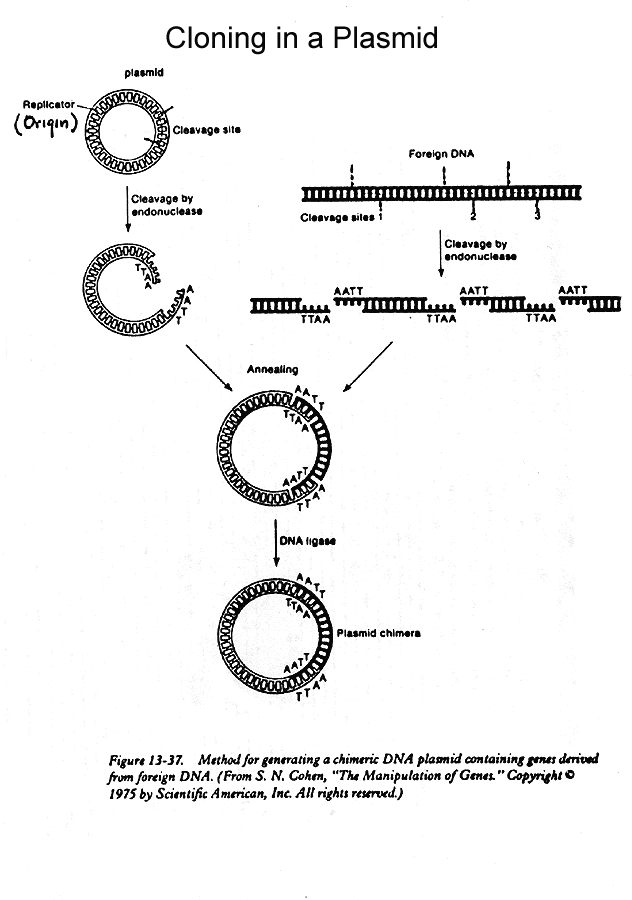
The primers have the sites for the restriction enxyme, and will cut the sample there. Later, it will be mixed with similarly restricted bacterial plasmids. Because both the plasmid and the sample DNA has been cut in the same with, they will be able to 'stick' to one antoher, and thus the mutant DNA will recombine into the bacterial plasmid, thus priducing a recombinant, transgenic, mutant genome.


DNA extraction from Gel Slices and the 2nd PCR Reaction
The DNA bands in the gel will be extracted using a QIAquick gel extraction kit, and then a 2nd PCR reaction will be done using the purified DNA as teh template.
QIAquick Gel Extraction Protocol
QIAquick Gel Extraction Protocol
- Weight the gel slice in a tube, making note to subtract the weight of the tube itself.
- Add 3 volumes of Buffer QG to 1 volume of gel. For this experiment it will be 630 microliters and 480 microliters for the A and B gels respectively.
- Incubate at 50 degrees Celsiu for 15 minutes.
- After the gel discolces completely, (noting that the mixture is a yellow colour), add 1 gel volume of isopropanol to each sample and mix.
- Place the QIAquick spin colum in a 2ml collection tube and put sample in.
- Centrifuge for 1 minute to bind the DNA
- Discard flow-through and place QIAquick column back in teh same collection tube.
- Add 0.75 ml of Buffer PE to QIAquick column and centrifuge for 1 minute.
- Discard the flow-through and centrifuge thet QIAquick column for an additional minute, at 13,000 rpm.
- Place the QIAquick column into a clean 1.5 ml microcentrifuge tube.
- Elute the DNA by adding 40 microliters of elution buffer to the center of the QIAquick column membrane. allow it to stand for 1 minute, then centrifuge for 1 minute.
2nd PCR Reaction Protocol
Into a single eppendorf tube, add via pipet:
- 40.5 microliters of H2O
- 1 microliter of Primer 1 ((the forward start primer)
- 1 microliter of Primer 2 (the reverse primer with teh stop codon)
- 1 microliter of dNTPs
- 1 microliter of the 10X PCR Buffer
- 1 microliter of Vent Polymerase
- 1 microliter of the template DNA from PCR A
- 1 microliter of the template DNA from PCR B
- Mix by pipeting 40 microliter volumes 2-3 times.
The toal volume should now be 51 microliters. Place this mixture into the PCR machine, set at 95 degrees Celsius. Then have one cycle of 5 minutes of denaturation at 95 degrees Celsius. Then have 30 repitions of this set:
- Denaturation at 95 degrees Celsius for 1 minute
- Annealing at 50 degress Celsisus for 1 minute
- Extension at 72 degress Celsisus for 1 minute
Followed by a single 10 minute extension at 72 degress Celsisus.
Gel Electrophoresis of PCR Products and DNA Purification



Continuing with the mutation of the VHL tumor suppressing gene experiment, the previous PCR products will ge run on agrose gels, and the PCR DNA will be purified for later use.
40 microliters of the PCR product will be run on teh gel via the following method.
- Pipet 2 small dots containing 4 microliters of DNA loading buffer onto a peice of parafilm.
- For PCR A, remove 40 microliters from the PCR tube by pipet and mix with the 4 microliters of DNA loading buffer by pipetting up and down a few times on the parafilm
- Pick up the mixed sample and load it inot one of the large wells on the gel, using the 10-100 microliter pipette, releasing slowly
- Repeat steps 2+3 for the PCR B. Leave an empty well between A and B PCR samples. There will be other samples from other groups sharing the same gel. A DNA ladder will be put into the first lane.
- Gels will run at 200 Volts for 20-30 minutes.
- The gel is then stained in ethidium bromide for approximately 20-30 minutes and then visualized under ultraviolet light.
- The glowing band of DNA will be cut out with a scalpel, taking care to get as little of the gel and as much of the DNA as possible.
- The two cut out bands will be placed into seperate eppendorf tubes, labeled, and will be used to extract the DNA itself later.
Unfortunately, upon following this procedure, it was found that no DNA from teh original PCR was present. There was no banding seen on the agarose gel, for any of the group samples, whereas the ladder did show banding. The staining was permited to continue for approximately another 20 minutes, with new concentrated ethidium bromide added to the staining solution, still the PCR bands failed to show up, stronly indicating that there simply was no PCR DNA.
Upon review, it was discovered that the orignal stage of the experiment was missing a critical component, the dNTPs, from which the PCR DNA is built out of.
The orignal stages were repeated with the correct procedure. After repeating the steps above, the bands did appear, and those bands were cut out and set aside in eppendorf tubes for later stages.
While the above gel was running for the second time, the remainder of the DNA (approx 40microliters) was purified using columns and buffers from the QIAquick PCR purification kit, using the following procedure.


- Add 5 volumes of Buffer PB to 1 volume of the PCR sample and mix. Since 40 microliters of sample are left, 200 microliters of buffer is used.
- Place a QIAquick spin column in a provided 2ml collection tube
- Apply the sample to the QIAquick colum and centrifuge fro 1 minute to bind the DNA
- Discard the flow-through. Place teh QIAquick column back into teh same tube.
- Add 0.75 ml Buffer PA to teh QIAquick column and centrifuge for 1 minute, to was the sample.
- Discard flow thru and place the QIAquick column back into the same tube and centrifuge for an additional minute.
- Place the QIAquick column in a clean 1.5ml microcentrifuge tube
- To elute the DNA into the microcentrifuge tube, add 30 microliters of water to teh center of the QIAquick membrane, allow it to sit for o1 minute to increase the DNA concentration, then centrifuge for 1 minute.
Now a restriction enzyme digest of this purified DNA will be set up, using the following protocol:
- Add 4 microliters of 10x Buffer#2 to the eluted DNA
- Add 4 microliters of BSA to the tube
- Add 2 microliters of the premade enyxme mix to teh tube (composed of HindIII/XhoI)
- Mix the contents ths far by setting the pipet to 25 microliters and gently pipetting up and down 2-3 times
What is now had is a tube containing a total volume of 40 microliters (the 309 microliter water+DNA sample, and the combined 10 microliters above). It is important to not hold the base of the microcentrifuge tube and thus warm it, because the restriction enzyme are refrigerated and are very heat sensitive.
This tube is now incubated at 37 degrees Celsius overnight, stored, and then used in later steps.
By this time the gels have run and have been stained and are ready for viewing (with UV protective face shields) via UV illumination. 
The ethidium bromide is UV reactive and also binds with DNA, thus when illuminated with UV light, the locations of the DNA bands, which have moved during electrophoresis, show up as glowing bands, similar to the gel phot shown below, however in this experiment there is only a single band (excluding the bands in the ladder DNA row), because only one fragment has been prepated (per row, the PCR row A, and PCR row B). It is these bands that are now cut out and placed into eppendorf tubes for later procedures.